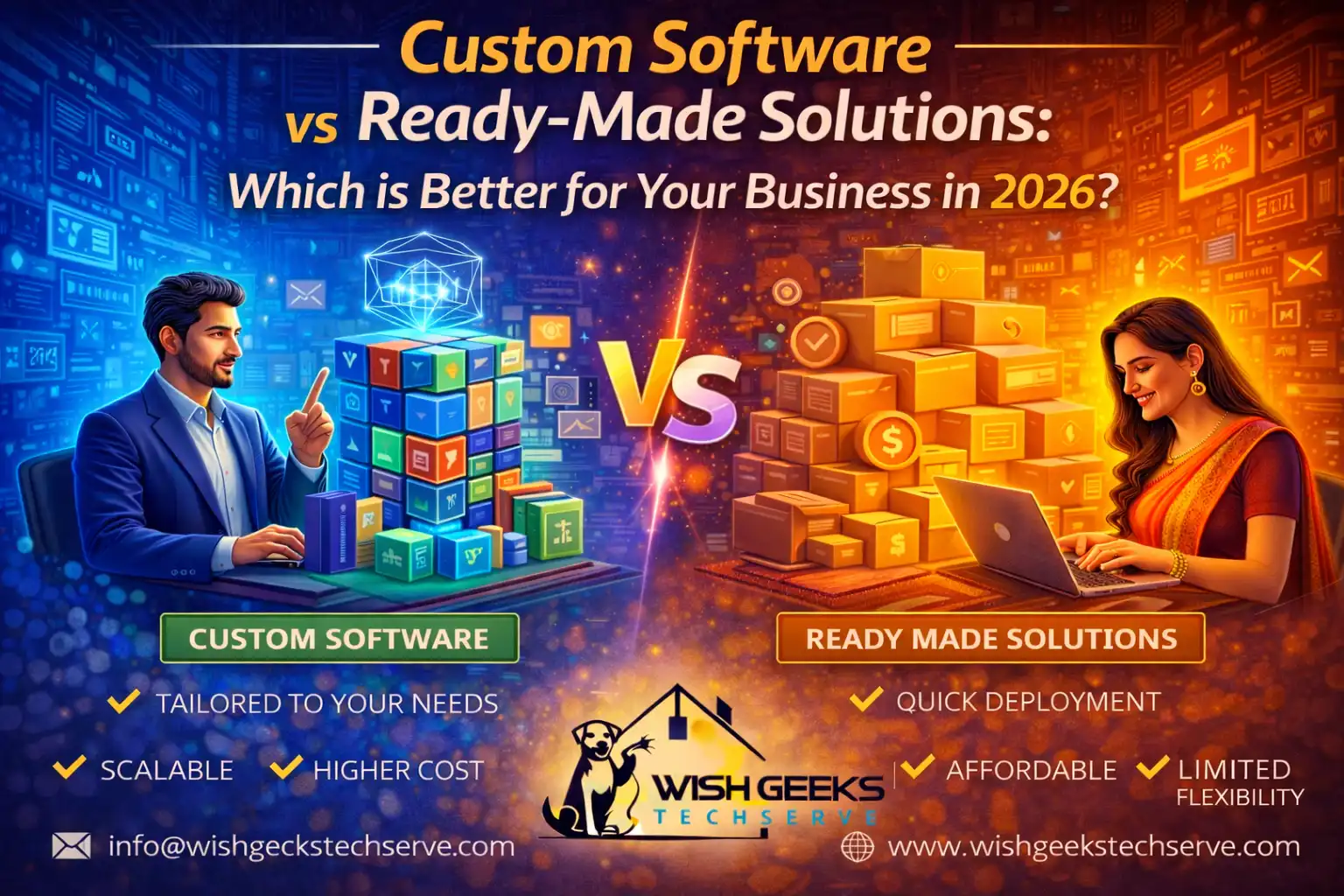
The question that is posed by a member of a leadership team every few months is: Why are we continuing to pay money on software that can hardly do what we require? It's a fair question. And the discussion on custom software vs ready-made solutions typically ensues in a passionate, inconclusive, and often determined by the loudest voice in the room. In fact, the debate around custom software vs off-the-shelf software and custom vs SaaS software often overlaps here.
We can simplify this process significantly. Let's have an open and constructive discussion to find the best way forward when comparing custom software vs ready-made solutions.
Tailor-made software is developed to suit your company. Your procedures, your group, your policies. It is not used by anybody. It is costly and time-consuming to construct, but once constructed, it functions just like your business. This is where the benefits of custom software development become evident.
Ready-made (off-the-shelf) software is a product that is designed to suit all people: Salesforce, QuickBooks, Shopify, and Zoho. You subscribe, install it, and begin using it. Quick and affordable in the short-term, but you are modifying your business to suit the software, not vice versa.
They are not necessarily better. The correct decision will be based on your circumstances, and frankly, the majority of businesses fail to do so, as they are comparing the wrong things in custom software vs ready-made solutions.
| Factor | Custom Software | Off-the-Shelf Software |
| Upfront Cost | Higher (one-time investment) | Low to moderate |
| Long-Term Cost | Lower (no monthly licensing) | Keeps growing year over year |
| Fit to Your Workflow | Built around you | You adjust to it |
| Time to Launch | Weeks to months | Days |
| Scalability | Designed to grow with you | Limited by vendor decisions |
| Security & Compliance | Full control | Shared infrastructure |
| Competitive Edge | Real differentiator | Same tool your competitors use |
| Customization | Unlimited | Surface-level at best |
| Support | Dedicated | General queue |
This table clearly highlights the difference between custom software vs off-the-shelf software and helps in understanding custom vs SaaS software decisions.
There's a reason companies that invest in custom software rarely go back to off-the-shelf tools. Here's what actually changes and why the benefits of custom software development matter:
With any generic platform, there's always a gap between how the software works and how your business actually runs. This gap is one of the hidden disadvantages of off-the-shelf software. You build workarounds. You train new hires on those workarounds. Over time, the workarounds become the process, and nobody remembers why things work the way they do.
Custom software eliminates that gap from day one. It's designed around your existing operations, not the other way around.
Most SaaS tools are loaded with modules, toggles, and dashboards that look impressive in a sales demo and collect dust in real life as you don't use them. Another example of the disadvantages of off-the-shelf software. You're paying for all of it. Custom software only includes what you actually need built to spec. This is one of the underrated benefits of custom software development.
Suppose a SaaS tool at ₹5000/month is ₹10,000 a year. Add per-user fees, add-on modules, and the annual price hikes that every vendor eventually introduces, and that number climbs fast. Custom software has a real upfront cost, but after that, you own it. No recurring license. No seat-based pricing. No surprise renewals. This is why the benefits of custom software development become clearer over time compared to custom vs SaaS software.
For most growing businesses, custom software pays for itself within two to three years. After that, the savings compound.
This one gets overlooked. When you use the same CRM or ERP as your competitors, you're operating with the same capabilities, you lose differentiation, and this is a major point in custom software vs off-the-shelf software discussions.
Custom software gives you something proprietary, a workflow, a feature, an integration that your competitors can't just download and replicate.
Off-the-shelf vendors are great at marketing. Less great at telling you about these things:
Vendor lock-in is real. One of the biggest disadvantages of off-the-shelf software is that after two or three years, your data lives inside someone else's platform. Migrating away is painful, expensive, and sometimes practically impossible. You don't notice the lock-in until you want out.
You're sharing infrastructure with thousands of other businesses. When the platform goes down, you go down. When they have a security incident, your data is involved. You have no control and limited recourse, another disadvantage of off-the-shelf software
The roadmap isn't yours. That feature you've been requesting for 18 months? It gets built when it makes business sense for the vendor based on the votes of thousands of other customers, not your specific need.
Pricing always goes up. Always. And once you're embedded in a platform, you have very little leverage when it does. It is one of the common disadvantages of off-the-shelf software
These disadvantages of off-the-shelf software often push companies toward custom software vs ready-made solutions reconsideration.
Stop going back and forth. Use this to make the call when evaluating custom software vs ready-made solutions:
The honest answer for a lot of businesses is that they start with ready-made and shift later to custom. This is common in custom software vs ready-made solutions journeys.
A few years ago, SaaS was the easy default for most businesses. Affordable, fast, no technical overhead. That's still true for a lot of use cases, but a few things have shifted. The discussion around custom vs SaaS software has evolved:
AI expectations have changed what "good software" means. Businesses now want AI built into their operations. Generic SaaS tools offer generic AI the same features every other user gets. Custom software can be built with AI that's trained on your data, understands your business logic, and makes decisions that actually make sense in your context. That gap is growing.
Regulations on data have become more stringent. GDPR, HIPAA, and a flood of nation-specific data regulations imply that shared SaaS infrastructure is becoming riskier for companies in sensitive industries. Custom software allows you to have control over the location of your data and its security.
The hybrid model is becoming the norm. Increasing numbers of businesses are building their own software to do their business and integrating best-in-class SaaS at the edges - Stripe to take payments, Twilio to communicate, AWS to run their infrastructure. You do not need to select one or the other completely.
A healthcare startup should have telemedicine workflows, HIPAA-compliant storage, and AI-assisted patient intake. There is no off-the-shelf tool that would cover all that. The only option is custom software.
Another online retail brand with a typical product line? Shopify is a great idea. Get to market fast, see if the business model works, and invest in custom features when you've earned the revenue to justify them.
A medium-sized manufacturer that had its own production workflows experimented with three ERPs and created more workarounds than the two ERPs could support. They eventually built custom. The switching cost was high, but they stopped losing time and data within the first quarter.
A FinTech company processing multi-currency transactions across 12 countries with regulatory obligations in each. Custom, without any debate. Compliance and performance at that level can't be outsourced to a vendor's roadmap.
We've built custom software for businesses across healthcare, logistics, finance, and retail. We've also talked clients out of custom builds when off-the-shelf was genuinely the smarter move. We'd rather give you the right answer than the expensive one.
Our software development services begin with a discovery process - knowing your business before writing a line of code. Based on that, we create scalable systems that are modular and can expand with you and integrate with whatever tools you already depend on.
When you are not certain about the direction that would be reasonable for your business, then that is precisely the type of discussion we are established to have.
If you're ready to figure out which path makes sense for where your business is headed, our custom software development services and team at Wish Geeks Techserve are a good place to start. No pressure, no sales pitch, just a straight conversation about what you actually need.
Talk to our team. Hire software developers who ask the right questions first.
Is custom software always more expensive?
Upfront, yes. Over three to five years, often no. The recurring cost of SaaS licensing adds up fast, especially as your team grows and your needs expand.
How long does a custom build take?
A focused tool (internal dashboard, client portal) can be ready in 6–10 weeks. A full platform takes longer, typically 4–9 months, depending on complexity. We work MVP-first, so you're using something real well before everything is finished.
Can custom software connect to tools I already use?
Yes. One of the best reasons to support custom software is integration. It can be integrated to work with your current CRM, payment processor, ERP, or any third-party API.
What happens when we change our needs once it is constructed?
Tailor-made software is developed to be updated. You do not have to wait until a vendor releases a quarterly release; your development team can change, add features, or rewrite modules as your business changes.
When do I need to hire software developers or purchase a tool?
When the workarounds are more expensive than the build. When your current software is actively slowing your team down. When you need something that simply doesn't exist off the shelf. Those are the right triggers.
Thank You for showing interest in our services. Here’s how you can reach us...

info@wishgeekstechserve.com

OUR ADDRESS
Sector-62, Noida, Uttar Pradesh




.7f54be30.webp&w=256&q=75)